
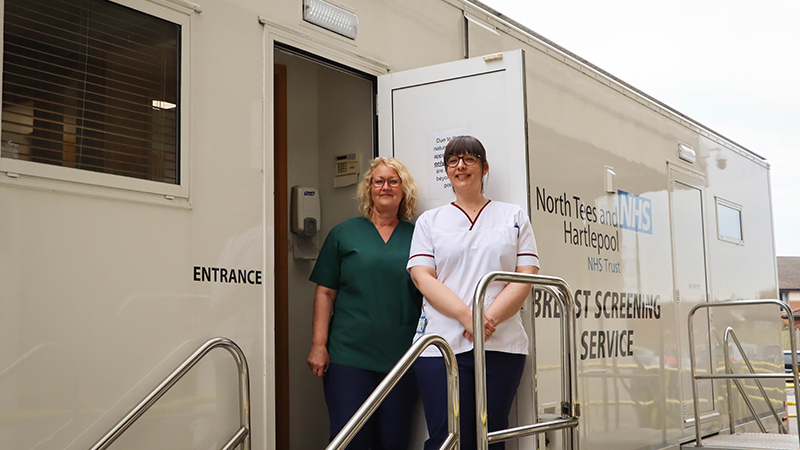
Breast Cancer is the most common cancer diagnosed in the UK. It is important that cancers are detected early. The earlier the diagnosis, the better the outcome. Breast screening can help us to see small changes in the breast which can be too small to be felt by you or your GP.
Why have I received a letter?
At North Tees and Hartlepool NHS Foundation Trust we work under the guidance of the National Breast Screening Programme and offer a well woman service to all eligible women who are aged between 50 and 71.
If you are in this age range you will be routinely invited for a mammogram – which is an x-ray of your breast tissue. You will be invited every three-years at a location which is convenient and close to where you live. No need to contact us as your invitation will arrive through the post.
You will usually be screened on one of our mobile units, at GP surgeries or within hospital grounds. We also have a number of static screening departments throughout the region.
Not all sites will run at the same time, but everywhere will offer a three-yearly mammogram. You will be offered an appointment at the closest distance to you. Or you can choose to book an appointment at an available site to fit your schedule.
It is important to know that even when you are beyond the age of 71 you can still book and attend for a mammogram. Women wishing to book an appointment should contact our admin team on the number below. They will be happy to help you.
If you are invited to one of our assessment clinics, you will receive a text reminder prior to this appointment.
Text reminder service
We offer text reminder services for routine mammogram appointments.
Contact to change your appointment
Get in touch (9am to 5pm, Monday to Friday) to change the time or date of your appointment.


What to expect at a breast screening appointment
What to expect at a breast screening appointment
Hi, I’m Shazia. I’m here to talk to you about breast screening.
I will take you through a breast screening appointment at Middlesbrough, provided by North Tees and Hartlepool NHS Foundation Trust,
This is a static site, but remember the same service and test is provided on the mobile vans arriving on the day.
There are signs to guide you.
You are welcome to bring someone along with you a support or to assist you. Please note, any male chaperones will not be permitted beyond reception in static sites or on the mobile screening vans, so you may wish to consider taking a female friend or family member.
Mammograms are done by a specialist called a mammographer. All mammographers in the breast screening service are women.
At reception, a friendly receptionist will confirm a few details with you, such as your name and address. Then you will be asked to wait in reception for your appointment.
When you are called through for your appointment, you will be shown to a changing room and asked to undress from the waist up.
Top tip it is advisable to wear something where you can easily undress to the waist and have something to put back on while you wait for your appointment. Wearing separate tops, slips, trousers, leggings, shalwar will make things easier.
Once you’re in the screen room, you would need to remove your hijab, your top or your kameez. You are in a safe female only environment when you do this so your modesty will not be compromised.
There will be no males beyond reception, which may help you decide if you wish to remove your traditional headwear.
Before going into the actual screening room, you can leave your belongings in the changing room. No one else will have access to this room.
This is a machine which will undertake the X-ray. The female radiographer will explain how the breast X-ray mammogram is taken.
Then you will be asked to fully undress from the waist up. You may have to rearrange and in some instances remove your headwear or hijab for a clear X-ray of your breast to be taken.
During the X-ray, four images would be taken – one of each breast from the front and one of each breast at an angle.
The mammographer will guide you into two different positions, which you will repeat for each side. They will also assist to make sure your breast is positioned correctly.
This will require the female mammography to physically position your breast on X-ray machine.
To get a clear image, the X-ray machine needs to touch your breast briefly to take the image. The machine will apply a little pressure on your breast as it touches it to take the image.
The pressure feels similar to the pressure you feel when having your blood pressure taken. You may experience some brief discomfort, but it should not be painful.
The pressure is applied for a short time. Once it images taken, it stops.
You will then be shown to your changing room to get dressed. Once you are dressed, you’re able to leave.
The whole appointment should take around six minutes
You will usually get your results within two weeks of your breast screening appointment. This will be sent to you by letter. We will also send this to the GP surgery that you registered with.
Try not to worry if it takes longer to get your results. You can call the breast screening service to see if they have any updates.
Sometimes some women after an appointment need to be recalled for another scan either because the image was not clear or something has been picked up that needs further investigation.
There is a high chance that you will need to be recalled if this is your first appointment, as there are no other images to compare your results to. But this is normal.
If anything is picked up in the images that your health professionals are concerned about, they will get in touch with you between breast screening appointments.
It is still important that you check your breasts regularly. Use this QR code to see the symptoms and signs of cancer available in different languages.
If you have any of these symptoms, get an appointment with your GP. Do not wait for your next breast screening appointment.
For more information about breast screening, such as what happens at your appointment or where you’ll have it, search NHS breast screening on the NHS website.
Do the Test! Go for it!
This a short information film about having a mammogram. The film has been made by and for women with a Learning Disability.
It also speaks to a wider audience.
Do the test! Go for it!
Do the test. Go for it. Taking the fear out of breast screening,
I call them spanking Boston boobs.
I call them doughnuts, actually.
My name is Doug and this is our film about getting women to go for breast screening.
Let’s meet everybody making the film.
Music
I’m Caroline.
Julia.
I’m Penny.
Hi, I’m Kelly.
Hi, my name is Ingrid.
Hello.
I have agreed to be filmed having a mammogram. We have been working together to make this film, sharing our stories and our ideas of what we want to put in this film. We are sharing our experiences of going for breast screening.
We’ve all been for breast screening and we’ve all had a mammogram. We want to tell you what we think about it. I want to share with women what happens when you have a test.
Breast screening is for women aged 50 and older. Why is it good for breast screening? It’s a test to check if your breasts are healthy.
This test is called a mammogram. A mammogram is a photo taken inside your breast. The test can find changes inside your breasts which are too small to see or feel. These small changes can grow and become cancer.
Cancer is a serious illness. You can die from it. Breast screening is a way of finding breast cancer.
So what is cancer?
Cancer is a funny word. It’s little cells going out of control.
Breast cancer starts when cells in the breast begin to grow out of control and get bigger in size. This forms a lump known as a tumour and it can spread to other parts of your body.
So going for breast screening is an important part of keeping healthy and looking after yourself.
In this film we’re going to look at Julia’s story.
“Come in.”
“Hi Julia.”
“Hi.”
“I have a letter for you.”
“Can you read it to me?”
“Yes.”
The letter invited Julia for breast screening to help save lives from breast cancer.
When I got the letter, I was shocked. I didn’t know what a mammogram was.
“Look Julia, there is a leaflet. They will do a mammogram. That is how they take a picture of your breast. Every woman is doing that.”
I thought I was going to die from breast cancer. I’d heard stories that other people had died from breast cancer.
“Is it important for you?”
“No, no. I’m not doing it.”
I hid in the toilet. I was scared and I was angry.
“Leave me alone.”
I thought they were not going to treat me as normal. Because of my learning disability, I thought they were going to treat me like a package with a label on it.
I didn’t want to do the test. I was worried it was going to go wrong.
Julia was worried about going for a mammogram, but after she talked to a carer she decided to go for her own health and wellbeing.
I knew I had to have the test to check for cancer.
“Good morning.”
“Good morning.”
“First of all, when you arrive in reception, can I ask you to confirm your name and address?”
“Yes.”
“And that your telephone number ends in 4736?”
“Yes.”
“Thank you very much. Here’s your leaflet back and could I trouble you to take a seat in the waiting room just over there?”
“Are you okay?”
“I think so.”
“What’s going to happen when we go in there?”
“It will be fine.”
We’d like to show you what happens when you go for breast screening.
Ingrid is a breast care nurse. She has offered to be in our film and have a mammogram.
“So Ingrid, why have you agreed to do this in the film?”
“Because I think it’s really important for people to know exactly what is going to happen when you have a mammogram.”
“I know I’m going to get changed.”
“Once you’ve got changed, you will wait in a changing room until the radiographer asks you to come in.”
“Hello Ingrid, are you ready?”
“Yes.”
“Thank you. Come on through.”
This is Helen. She is a radiographer and she is going to be doing the mammogram.
“Hello. The radiographer will always be a woman.”
“So Ingrid, can you confirm your full name?”
The first thing they will ask you is to confirm your name and date of birth.
“Lovely, thank you. So Ingrid, we’ve got four X-rays to do. We do a top-to-bottom image on each breast and then we do a side view to get right up into the armpit and all the way down the side of the breast.
Imagine my hand is your breast. I’ve positioned you and I’m happy with the position. Then the compression plate comes down. It is a bit tight and uncomfortable, but it’s not for long, about five seconds. As soon as I’ve taken the image, that will automatically release.
If at any time you want me to stop, all you have to say is stop.”
“Okay.”
“What I will need though, Ingrid, because your hair is slightly longer, is for it to be tied back because sometimes that can shadow the breast. Do you have anything?”
“Oh brilliant, okay.”
“Lovely. I’m going to put on some gloves. While I’m doing that, could I have your top please?”
“Okay.”
“I’m going to put it on the chair over there.”
“Lovely, thank you. We’ll get started.
We’re going to do the right breast first of all.”
The X-ray machine may hurt a little bit, but this will only be for a few seconds.
“I’m just going to place you right in the middle of the table. Remember I said it was going to be tight and uncomfortable, but it’s lovely. Nice, relaxed shoulders for me.”
“Okay.”
“So I’m happy with that. Keep really still. I’m going to take that image now.”
The image of the right breast is taken.
“Lovely. We’re going to do exactly the same on the left breast.”
“Okay Ingrid, we’ve just got the side views to do now. I’m just going to angle the machine so it’s going to tilt and then I’ll get you into position. We’re going to literally lean onto the machine.”
Music
“I’m just making sure you’re in exactly the right position. Down comes the compression plate again. Okay, really still Ingrid. I’m going to take that one now.”
“Lovely, thank you.”
“We’re finished.”
“All finished?”
“All finished. You’ll receive a result letter in the post in about three to four weeks. Once you’re dressed, just let yourself back out the other side of the cubicle.”
“Okay, thank you very much.”
“Thank you.”
The screening test will only take a few minutes. You’ll be at the screening unit for about half an hour.
They took photos of my breasts. I was a bit sore and I felt uncomfortable, but it was okay. It wasn’t as bad as I thought.
We’ve all been for breast screening. We have all had a mammogram. Let’s hear what everyone thought.
I was shocked, but I was fine. It was just a bit scary.
The staff at the unit were talking to me. They knew I was in a wheelchair, so I did the test sitting down. They were able to arrange the machine for me.
It felt a bit sore. My breast felt a bit like it was being squeezed.
“How did you feel when you took your top off?”
I was nervous. It was embarrassing.
It squeezed my breast to take a picture. It didn’t feel very nice.
After the test they say you’ll get a letter with your test results.
After the mammogram, Julia asked every day about the results.
I thought the results were going to be bad.
Most results are normal. This means you don’t have to go for screening again for three years.
“I will read it for you.”
“Yeah.”
But sometimes women might need to go back for some more tests.
Let’s go back to Julia’s story.
“I now have the results from your recent mammogram.”
When I got the result letter, they wanted me to go back. I was scared. I thought I was going to die from breast cancer.
When Julia got the letter she was very worried.
“Don’t worry Julia.”
“Yeah.”
“We are doing the best we can. We are doing what we need to do.”
Like Julia, a few women will be asked to go back to the breast screening unit to have more tests.
I went for some more tests and everything came back normal.
Next time I go for the test, I won’t be scared.
If these extra tests show you might have cancer, someone will talk to you about what happens next.
We hope this film has explained the process of going for breast screening.
Remember, getting your breasts checked and getting the test result are all part of a process of looking after yourself and staying healthy.
You’ll be asked to go for breast screening again every three years.
If you are worried about going for breast screening, speak to your key worker. They can help you.
If you need extra support to go for your mammogram, you can contact your local learning disability team.
I’ve done the test and I won’t be worried next time. I know what to expect.
Breast cancer can kill, but the earlier it is detected, the better.
Remember, you don’t have to pay for the test. It’s free.
So ladies, if you’re offered the test, take it. It might save your life.
Go and do it today.
Music
Thank you for watching our film.
Very high risk breast screening for some women following chest radiotherapy for Hodgkin lymphoma
The NHS is contacting a group of 1,487 women across the country who had radiotherapy above their waist to treat Hodgkin lymphoma when aged between 10 to 35 years during 1962 to 2003 who should have been referred for annual MRI checks (and depending on their age, a mammogram).
As the regional breast screening unit, we will follow up this initial contact to the small number of women in our communities who have been identified as higher risk with letters from week commencing 11 March 2024.
We understand that some women will be concerned but we will contact every woman identified, offering appointments and support as required. You do not need to contact us beforehand.
The NHS website has more information.
Our Screening Locations
Our locations can be found on the breast screening locations page.
Please be aware that not all locations are available all the time. Locations vary over a three-year rotational period.
Please note:
If you are worried or have concerns about any changes to your breasts, please see your GP immediately. Do not wait for your screening invitation.
Frequently asked questions
A full resource of our commonly asked questions can be found on our frequently asked questions page.