
Information for patients
This leaflet can be made available in other formats including large print, CD and Braille and in languages other than English, upon request.
This leaflet informs you about stage 1 post-operative exercises and advice following a reverse shoulder replacement or a total shoulder replacement.
Before you are discharged, a member of the inpatient therapy team will guide you through the exercises. They will provide you with advice and answer any questions you may have.
You will then be contacted by the outpatient physiotherapy team, who will provide you with advice and exercises to aid in your recovery.
What can I do to help myself?
It is very important to get as much movement back in your shoulder as soon as you can. This will mean you can start to use your shoulder normally and perform your daily functions.
Managing your pain and doing your exercises every day will help this to happen quicker. If you require it, pain relief can be very useful to help minimise any pain and therefore give you the confidence to exercise and use your shoulder.
If you have been given pain relief, you should take them as prescribed. You should always read the label if using over-the-counter medication and, if you are in any doubt, speak to your pharmacist or GP. If your pain becomes severe or is continuous, you should contact your GP.
What exercises should I do following my surgery?
Once the nerve block has fully worn off and you have feelings back in your arm, you may start your home exercise programme. This usually takes between 12 to 48 hours.
You should aim to perform the following exercises 3 times a day. Perform 10 repetitions, have a rest for 1 minute and repeat a further 10 times.
During your operation, your surgeon will decide on a range of movement that you can move your shoulder in without causing any significant stress on the surgical repair. This is called the safe zone
The safe zone is there to give you the confidence to perform your exercises. The inpatient therapy team will educate you on what your safe zone is and your outpatient physiotherapist will progress and guide your future rehabilitation.
It is normal for you to feel aching, discomfort, or stretching feelings when doing these exercises. If you experience intense and lasting pain (e.g. longer than 30 minutes), do the exercises less forcefully or less often. If this does not help, you should discuss the problem with the Physiotherapist.
Exercise 1: Seated Table Slides
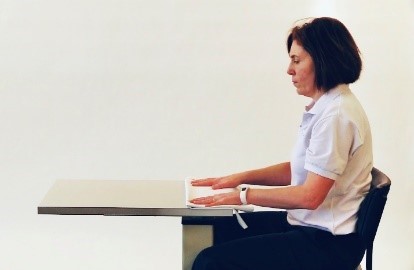
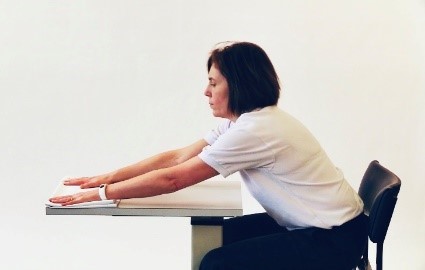
While sitting, rest your hands on a table. Using a duster or similar object, lean forwards and slide your hands away from your body to as far as comfortable and then return to the start position.
Exercise 2: Shoulder Short Lever Active Assisted Flexion
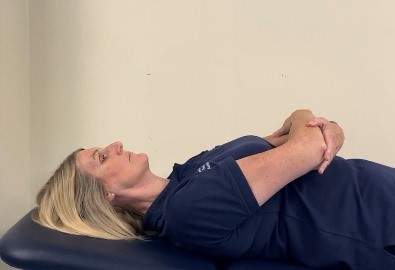
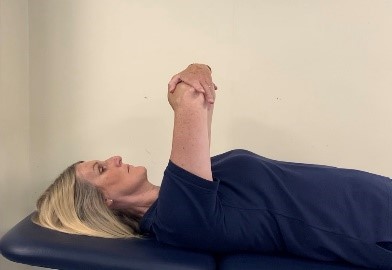
Lying on your back with your knees bent and feet flat on the bed. Support your operated arm underneath your elbow with your unaffected hand.
Using help from your unaffected arm, slowly lift your operated arm up and away from your chest. Stop at the recommended height from your surgeon (Safe zone). Return to the start position.
Note: You can perform the exercise lying on your back as indicated in the above images or seated. Find which position is most comfortable for you.
Exercise 3: Shoulder Active-Assisted External Rotation to Neutral
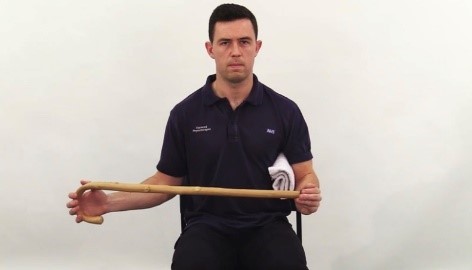

Start with your hand on your tummy, bend your elbow to 90 degrees, as shown in Image 1 and 2. Tuck your elbow in by your side with a rolled towel in between your upper arm and body.
Holding a stick or similar object, keeping your elbows in at your side, use your unaffected arm to push the stick outwards to rotate your operated arm through your safe zone. Return to the start position.
Note: You may find it more comfortable to support your arm on a pillow. Some people find this more comfortable to do while lying (Image 2). Find which position is most comfortable for you.
Contact numbers
Upper Limb Secretary
Monday to Friday, 9.00am to 5.00pm
Telephone: 01642 624442
Physiotherapy Appointment Queries
Monday to Friday, 9.00am to 5.00pm
Telephone: 01429 522471
Ward 32/33
24 hours 7 days a week
Telephone: 01642 382832 or 01642 382732
Useful links
North Tees and Hartlepool Foundation Trust
Upper Limb (Shoulder, elbow, hand, and wrist Surgery) – patient information.
Website: https://www.nth.nhs.uk/services/traumaorthopaedics/upper-limb/
References
Payne, C, Jaggi, A, LE, Leu, A, Garofalo, R and Conti, M. (2015). (v) Rehabilitation for shoulder arthroplasty. Orthopaedics and Trauma,29(5), PP.314-323.
Wolff AV, Rosenzweig L. Anatomical and biomechanical framework for shoulder arthroplasty rehabilitation. Journal of Hand Therapy. 2017; 30: 167/174
Patient Experience Team (PET)
North Tees and Hartlepool NHS Foundation Trust would like your feedback. If you would like to share your experience about your care and treatment or on behalf of a patient, please contact The Patient Experience Team who will help you to do this.
This service is based at the University Hospital of North Tees but also covers the University Hospital of Hartlepool, our community hospitals and community health services.
North Tees and Hartlepool NHS Foundation Trust
Telephone: 01642 624719 / Freephone: 0800 092 0084
Email: [email protected]
Monday to Friday, 9:30 am to 4:00 pm
Email: [email protected]
Out of hours
Out of hours if you wish to speak to a senior member of Trust staff, please contact the hospital switchboard who will bleep the appropriate person.
University Hospital of North Tees
Hardwick Road
Stockton-on-Tees
TS19 8PE
Telephone: 01642 617617
University Hospital of Hartlepool
Holdforth Road
Hartlepool
TS24 9AH
Telephone: 01642 617617
Email: [email protected]
Leaflet Reference: PI076
Date for Review: 15/06/2029