
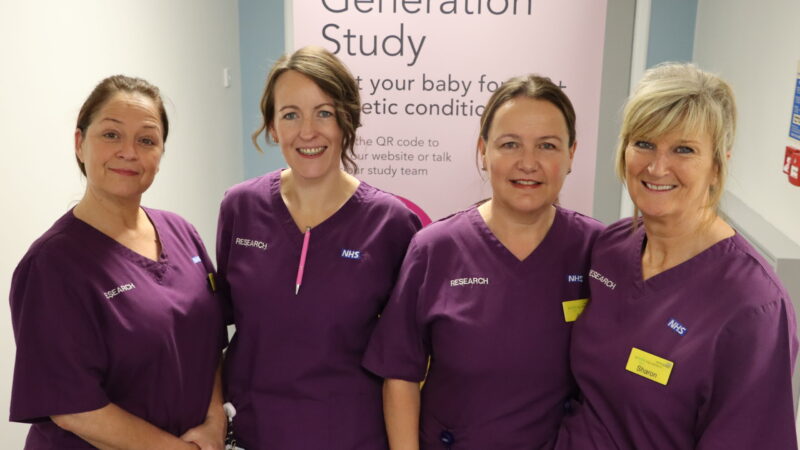
A national research study screening babies for more than 200 rare genetic conditions is being taken up by a hospital in Teesside.
The maternity research team at the University Hospital of North Tees is taking part in the Generation study investigating the early diagnosis and treatment of rare conditions that may develop in early childhood.
As part of the study, a baby’s genome is sequenced shortly after birth, using a small blood sample taken from the umbilical cord with parental consent.
This will test for many childhood‑onset genetic conditions where early treatment is already available.
Sharon Gowans, research midwife, said: “This trial will help us to look at whether genomic screening at birth is feasible, accurate, and beneficial.
“It will also improve understanding of this type of information and this data could help us to diagnose and treat rare diseases earlier.
“It has the potential to have a very positive outcome that could improve how we can care for someone who carries one of these rare conditions.”
The genome is sequenced and analysed for specific conditions chosen by clinical experts.
Results are returned to parents by a specialist if a condition is suspected, then further diagnostic testing is offered, which will result in earlier interventions.
Stephen Wild, obstetrician and gynaecology consultant and principal investigator for the study, said: “The study aims to determine whether genomic screening should become part of future NHS newborn screening.
“The Generation study is one of the world’s most ambitious newborn genomics projects. If successful, it could reshape how the NHS detects and treats rare genetic conditions, giving thousands of children a healthier start in life.”
The study is being led by Genomics England in partnership with NHS England and aims to recruit 100,000 newborn babies across England.
For more information and register your interest in the study, visit the Generation study website.