
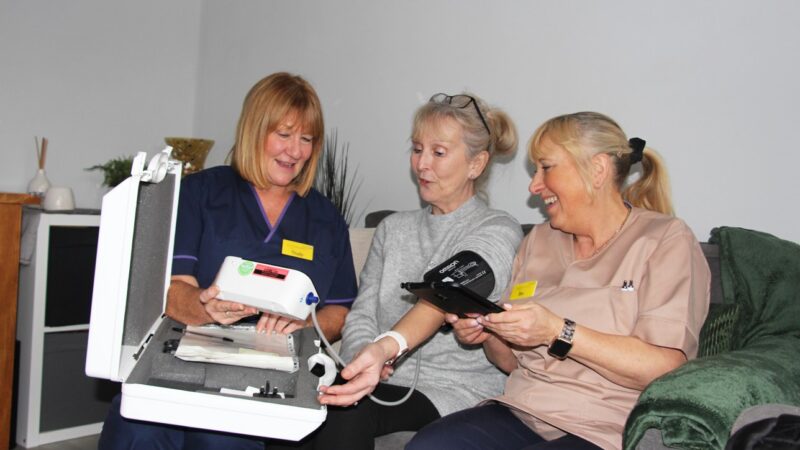
FOR two years nurse practitioner Janice Oliver lived with a breathlessness she couldn’t shake.
She blamed the after-effects of COVID and lifestyle changes after moving into a bungalow, but it didn’t cross her mind that her heart was weaker than it should be.
Overtime her symptoms worsened, leading to dizziness and a near collapse.
She said: “Not once did I think it was my heart. I always had a high pulse, but it wasn’t bad enough to have caused concern or make me go to a doctor about it.”
Now, as she navigates the road to recovery, the 61-year-old from Stockton-on-Tees, has shared her story, during National Heart Month, to champion the hospital service that became her lifeline.
After treatment for vertigo failed to improve her symptoms in November 2025, Janice was referred by her GP for a blood test, which in turn led to an echocardiogram (ECHO).
The following day, she received the shock diagnosis of severe heart failure.
“The doctors were just as surprised as I was,” she said.
Just before Christmas, Janice was quickly referred to University Hospitals Tees’ award-winning cardiac remote monitoring service.
Home is where the heart is
The cardiac remote monitoring service supports patients with heart failure, like Janice, manage their condition in the comfort of their own home.
The service was set up by North Tees and Hartlepool Hospitals NHS Foundation Trust in 2023, following funding from NHS England.
Since then, it has helped around 250 heart failure patients, and it is currently supporting 20 patients at any one time.
Using a special app and a monitoring kit given to her by the team, Janice has been recording details including her blood pressure, heart rate, oxygen saturation and weight.
These recordings are reviewed by the specialist heart failure team allowing them to closely monitor her condition and respond quickly if any concerns are flagged.
Despite not being confident with technology, Janice says the kit is easy enough to use.
“Knowing someone is constantly keeping an eye on you is incredibly reassuring.”
She said: “The team, including specialist heart failure nurse Trudy Hunt, took the time to show me how everything worked and they’re always on the other end of the phone.
“Trudy rings me straight away if any data I’ve input causes concern to see if I’m ok or if I need an ambulance.
“Knowing someone is constantly keeping an eye on you is incredibly reassuring.”
Janice’s medication is adjusted, using the data she uploads via the specialist app, and when her doses are stable (optimised) she will have another ECHO to determine future interventions.
Four weeks after being referred to the service, although Janice still has challenging days, she is starting to see progress thanks to the cardiac team.
She said:” The team have been a huge help, both physically and mentally.
“If I had to travel hospital every week, I would have struggled because of my breathlessness. The service has saved me a lot of stress and anxiety.”
The cardiac remote monitoring service, previously known as managing heart failure at home, is part of a national approach that supports people to live well at home through remote monitoring and patient education.
Since North Tees and Hartlepool was selected as a pilot scheme in 2022, the service has gone from strength to strength.
It has led to the development of a virtual heart failure ward and it has been rolled out across the trust’s cardiac rehabilitation service as well as to heart patients cared for by South Tees Hospitals NHS Foundation Trust.
Trudy Hunt, heart failure specialist nurse said: “We are extremely proud to be flying the flag for remote community cardiac care.
“Over the years, the service has increased productivity, reduced hospital appointments, reduced did not attends (DNAs), enabled more timely outcomes for our patients, reduced bed stay days and increased capacity for early hospital discharges.
“The remote monitoring service is personalised to the individual and it is the patient’s choice to be monitored in this way.”
Trudy and her team have seen huge progress and fantastic outcomes following treatment with some of their patients having an improvement in the strength of their heart.
She added: “Through remote monitoring, we are able to reduce the time for optimisation of medication from approximately five to six months to two to three months.”
How the team is performing
Performance figures for the team are generated yearly and comparing performance figures from 2022 to 2023 to 2024 to 2025 show:
- An increase in caseload by 10.45%
- A decrease in DNAs by 15.16%
- Increase in non-face to face contacts by 37.04%