
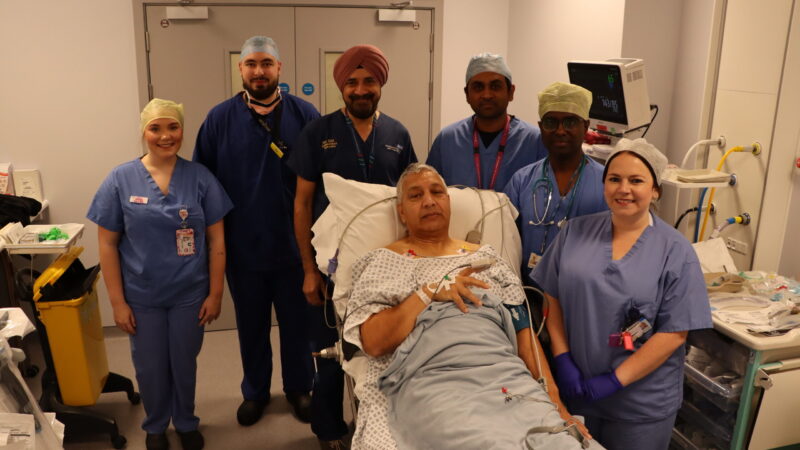
A man who has become a hospital surgeon’s 200th patient he has operated on using a special robot has praised the state-of-the-art technology.
Marn Singh from Fairfield had a tumour in his bowel removed in a procedure carried out at the University Hospital of North Tees by surgeon Talvinder Gill.
He is the 200th patient Mr Gill has performed colorectal surgery on using the robot – with the robot being used more than 700 times in total by surgeons in the hospital’s operating theatre.
Marn, 68, was diagnosed with bowel cancer after discovering blood while going to the toilet, which led to a referral for a colonoscopy investigation and a scan.
Speaking the day after surgery, he said: “The whole procedure was so professional, it was mind blowing.
“The whole team was so reassuring, they fill you with confidence that whatever they were going to do was going to be the right thing for me.
“They put me in a fantastic mindframe. I’ve got up this morning and I feel okay.”
“It’s incredible having the robot”
Speaking about the robotic technology, he said: “A friend of my wife’s had the same procedure at North Tees using the robot – they gave me a glowing report of Mr Gill and his team, I knew I was in the best of hands.
“Prior to this I had never heard of robots being used to help carry out operations, it’s incredible and gives you even more confidence.”
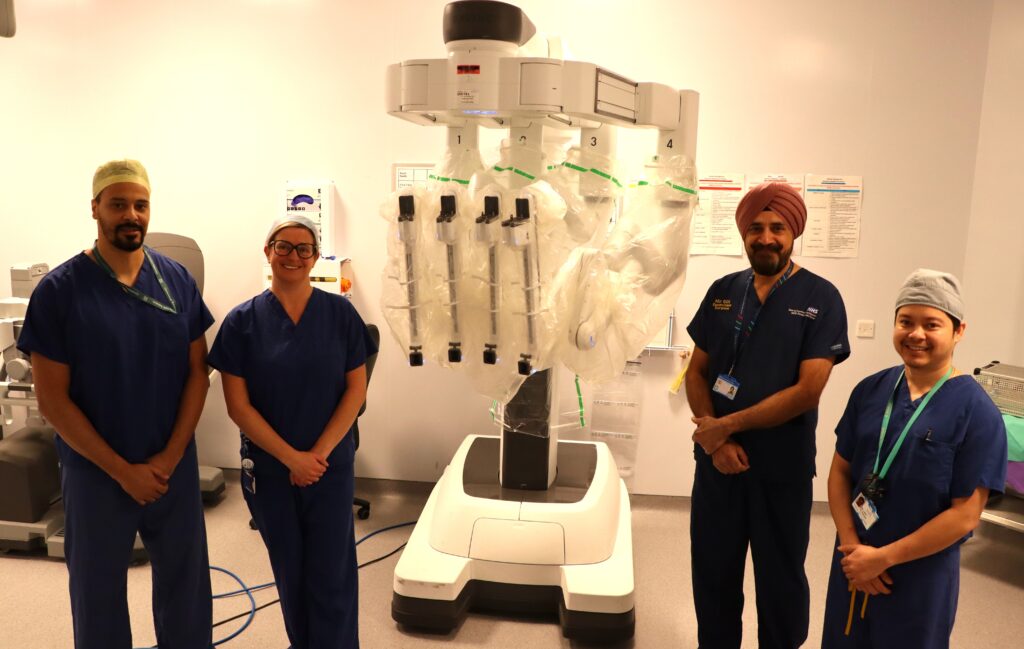
The Da Vinci robot, controlled remotely by surgeons, improves the accuracy and efficiency of surgery in complex operations – leading to improved outcomes for patients.
First used at North Tees in July 2022, it allows surgeons to perform delicate and complex operations through a few small incisions with robotic-assisted surgery.
It can adjust in various way to help surgeons get a good fit for their height and reach and gives them total control of the wristed instrument on each of the four arms, with live images produced in 3DHD.
Mr Gill explained: “The robot has really helped us provide a better outcome for patients.
“It means we can be as accurate as possible, while seeing everything clearly using a 3D image displayed.
“It is more accurate, less invasive and leads to reduced complications. It means our patients have a more successful outcome and a quicker recovery time after surgery.”
Rebecca Poyser, the unit’s colorectal surgical care practitioner, has led on the training programme for registrar doctors and resident doctors in using the robot.
Changed surgery for the better
She said: “All of our colorectal surgeons use the robot and I have led the training for many other of our doctors.
“I have personally been involved in more than 400 cases using the robot, it’s been an amazing journey.
“It has been a real game changer, it has changed surgery for the better – before now, we could be stood for hours holding equipment in position. It was very tiring, my back would hurt for days afterwards.
“This technology finds the very best angles so surgeons can see the full picture and help provide the best outcome for patients.”
Laith Al Rabadi, one of the registrar doctors trained in use of the robot, said: “It has been fantastic to be part of the journey using this technology.
“It’s not only helping our patients get the best treatment but has provided a great environment for doctors like myself to learn and develop their skills and knowledge.”